Tetsuya Chiba, the manga artist behind Ashita no Joe, died in a Tokyo hospital on October 22. He was 87. The cause was a myelodysplastic syndrome, a cancer that disrupts the blood cells produced in bone marrow. NHK and Comic Natalie reported the death on October 27.
His health had been failing in public view for years. In late 2021 he was hospitalized in Tokyo after feeling unwell through the summer, and he described problems arriving one after another in his heart valve, coronary artery and throat, including treatment for a tumor in his throat. January 2022 brought surgery to place a stent in a coronary artery. A blog post in 2024 mentioned eye surgery. On September 25 he put his long-running Hinemosu Notari Nikki on hiatus and gave his health as the reason.
A career that began in a classroom
Chiba was born in Tokyo and spent his early childhood in what is now northern China. He turned professional in 1956, at 17, while he was still in high school. Sit with that for a second. He had a paying manga career before he had a diploma, in an industry a fraction of the size it is today.
Ashita no Joe is the work that outlived everything else. He drew it from 1968 to 1973, and the story of Joe Yabuki, a homeless boxer with a talent for throwing his own life away, became one of the defining Japanese pop-culture texts of the postwar decades. Two television anime followed, in 1970 and 1980, then two films in 1980 and 1981. The ending of the 1980 series is still argued about by people who were not born when it aired.
The franchise kept finding new ways back. Megalobox, a 2018 reimagining that moved the story into a science-fiction setting with new characters, credits the original manga as its origin. Megalobox 2: Nomad followed in April 2021. English readers finally got an official version of the source material in December 2024, when Ashita no Joe: Fighting for Tomorrow was published.
The honors arrived late and kept arriving
Chiba was nominated to the Japan Art Academy in 2022 as one of the first two manga creators admitted, alongside Yoshiharu Tsuge. He was chair of the Japan Cartoonists Association. In 2024 he received the Order of Culture, becoming the first manga creator to hold that honor, which is given for outstanding contributions to Japanese culture.
That sequence says something about how the country's cultural establishment changed during his lifetime. In 1956 he was a teenager nobody had heard of, drawing to deadlines. By the end of his life the state had formally thanked him for the work, and done it before anyone else in his profession.
What is left
Hinemosu Notari Nikki, his autobiographical essay manga, started in Big Comic in December 2015 and was on hiatus when he died. On November 6, Big Comic confirmed that the eighth volume will be the last, shipping on February 12 alongside a book marking his 70 years as a manga artist. The details are in our report on Hinemosu Notari Nikki’s final volume.
For anyone outside Japan who wants to start somewhere, Megalobox is the easy door. It asks nothing of you and it is a different story wearing the original's skeleton. The 1970 and 1980 series are the real thing, and the manga is finally available in English in an edition he lived to see.
He drew for seventy years. That span runs from the years when weekly manga magazines were still a new idea to a streaming era that is now selling his work to readers born long after he had slowed down. Very few artists get to watch their first success become history and then keep working through it.
Source: Anime News Network, citing Comic Natalie and NHK
Source: Anime News Network, citing Comic Natalie and NHK
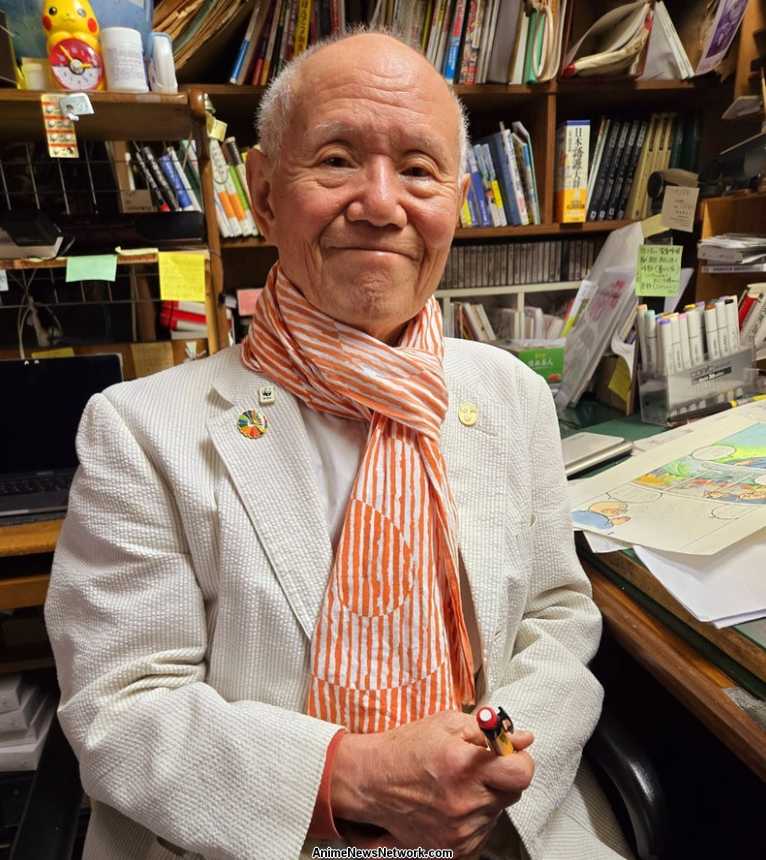
Featured image: Tetsuya Chiba, via Anime News Network.