The Art of Manga exhibition opened at the Brooklyn Museum on October 3 and stays up until January 31, 2027. It is the show’s East Coast debut after a run at the de Young Museum in San Francisco, and it brings 658 pieces of original artwork with it.
That number is the whole point. These are not reproductions or digital prints. They are ink on paper, the actual sheets that went to the printer, complete with whiteout, screentone and the occasional stray mark. Seeing manga at that scale changes how you read it.
Who is in the show
Eight artists anchor the exhibition, in this order: Rumiko Takahashi, Jiro Taniguchi, Mari Yamazaki, Hirohiko Araki, Fumi Yoshinaga, Gengoroh Tagame, Kazumi Yamashita and Eiichiro Oda. The lineup covers roughly five decades of Japanese comics and several completely different approaches to drawing. Takahashi built her pages around timing and reaction faces. Taniguchi built his around atmosphere and silence. Araki treats bodies like sculpture. Yoshinaga and Tagame both work in areas the form rarely gets credit for from Western readers.
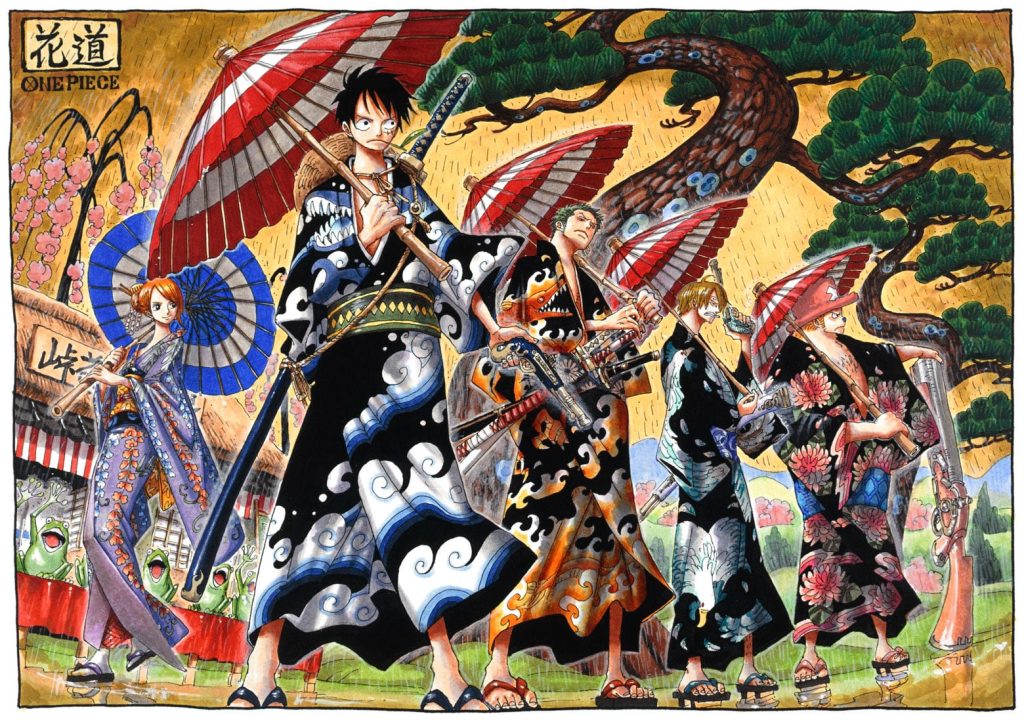
For a museum audience, the One Piece room is the obvious draw. A full gallery of Oda originals, some from the very early chapters, hits differently than a shelf of volumes. But the Taniguchi and Yamashita sections are the ones that tend to convert people who assume they do not like manga.
What changed from San Francisco
Organizers describe the Brooklyn version as close to the San Francisco one but not identical, and the differences run in both directions.
One addition is a set of pages from Jiro Taniguchi’s short manga Hundred Year Lineage, which comes from the anthology To Own a Dog and Also a Cat. The story follows a girl forced to give up her dog during World War II rationing, and the two reunite after the war. It has never been published in English, which makes the Brooklyn showing the first chance most visitors will have to see it at all.
One subtraction is the printing press. The de Young’s One Piece room included a full-scale press as part of an explanation of how manga gets manufactured. Brooklyn has a video installation covering the same ground instead. That trade is a little disappointing if you saw the San Francisco version and a little irrelevant if you did not.
The most interesting new element sits outside the exhibition proper. In the space before the entrance, the Brooklyn Museum has assembled traditional Japanese art from its own collection under the title “Manga Before Manga.” Ukiyo-e prints and emaki scrolls are arranged so you can watch the mechanics of comics assemble themselves, including the slow arrival of the word bubble.
Kawanabe Kyosai’s prints of warring frogs read as ancestors of Fujio Akatsuka’s Beshi, the frog character used as the show’s mascot, and a Utagawa Kuniyoshi woodblock of the folk hero Kaidomaru maps neatly onto a few centuries of shonen protagonists. It is a clever piece of curation. Instead of opening with a wall of text explaining that manga has roots, the museum lets you see the roots first and then walks you into the main rooms.
How the show got built
Exhibition curator Nicole Coolidge Rousmaniere, who led the San Francisco version, said the Brooklyn installation gave each artist more room. “What Brooklyn has done is really highlighted each of the artists in their own individual fashion, really beautifully spacing it out, and I think it’s the most immersive format they could have done,” she said during a press tour.
Brooklyn Museum curator Joan Cummins had a different set of problems. “It’s almost an identical show, but it’s in a very different space,” she told Anime News Network. The gallery is a room from around 1900 with columns and two different ceiling heights, and fitting 658 framed works into it took real planning.
There was also a diplomatic layer. Publishers passed along one rule during the San Francisco staging: rival artists should not be hung next to each other. Cummins would not say which artists had history, though she noted that alternating between male and female artists helped avoid the problem entirely.
She also had to explain the subject to her own institution. Several board members did not know what manga was, or assumed it was the same thing as anime. Cummins has said her own first exposure to manga while traveling in Japan was not warm, and that she read at least one volume of every series in the show to prepare, with a particular fondness for the historical titles: Yamashita’s Land, Yoshinaga’s Ooku and Takahashi’s MAO.
If you are going
Photography is allowed in the “Manga Before Manga” section at close range. Inside the main exhibition, photos have to be taken from a distance and video is not permitted.
Cosplay is welcome for the whole run. Brooklyn does not schedule dedicated cosplay days the way the de Young did, with the exception of the museum’s Halloween party, but costumes are fine any time the doors are open.
The run is October 3, 2026 through January 31, 2027.
Why it matters
Manga exhibitions in the United States usually mean a handful of framed pages in a convention hall, or a licensing booth with cardboard standees. A major encyclopedic museum giving 658 original drawings four months and a dedicated gallery is a different category of event. It is also the kind of thing that moves the form out of the pop-culture bucket in the eyes of people who fund museums.
The bigger test comes after January. If the show draws well, other institutions get a template to copy. Compare that with what happened to the Yuriten 10th anniversary exhibition, which collapsed under artist backlash over AI-generated art. Museums are watching how these events go.
For readers, the practical advice is simple. Go if you can, and budget more than an hour. The pages reward close looking, and there are 658 of them. If you want a sense of how deep the history runs, our piece on Masako Watanabe covers an artist who was drawing shojo manga when most of this show’s audience had not been born, and Billy Bat’s Harvey Award win shows how the awards circuit has shifted toward work like this.
Featured image: One Piece color artwork by Eiichiro Oda, via Anime News Network.
Source: Anime News Network — Bringing the ‘Art of Manga’ to the Brooklyn Museum