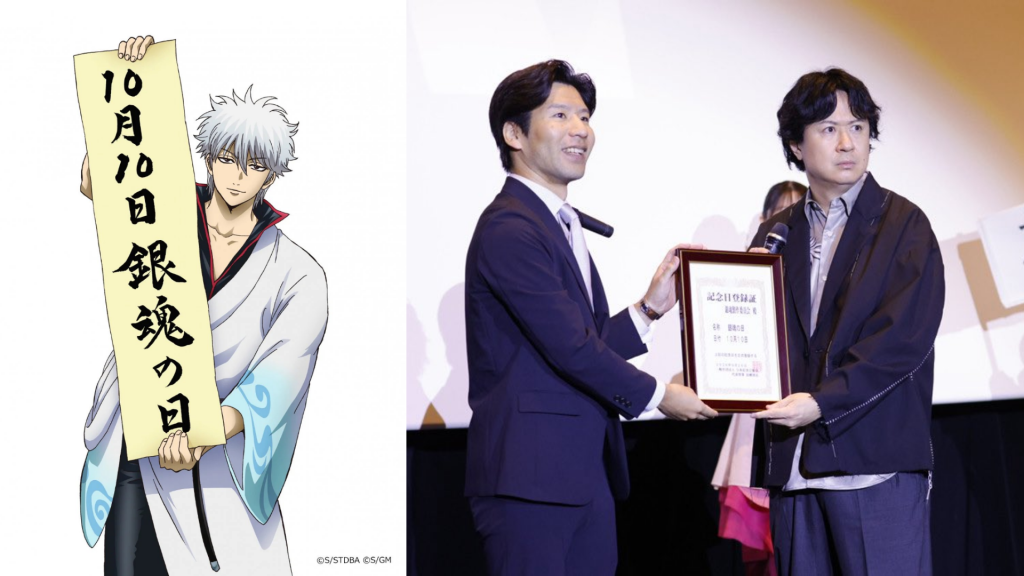
October 10 has officially been registered as “Gintama Day” by the Japan Anniversary Association, the organization that certifies commemorative dates in Japan. The date was chosen to coincide with the birthday of Gintoki Sakata, the protagonist of Hideaki Sorachi’s long-running manga and its anime adaptation.
The designation was announced on September 26 during a stage event tied to the release of the special “Cho Enjo” version of the reanimated Gintama: Yoshiwara in Flames Arc film, which opened in Japanese theaters on September 25. The event doubled as a look back at the anime’s roughly 20-year history.
Who was there — and who received the certificate
Tomokazu Sugita, who voices Gintoki, attended alongside Daisuke Sakaguchi (Shinpachi Shimura) and Rie Kugimiya (Kagura). Former Gintama editor Kohei Onishi and anime producer Hiromitsu Higuchi were also present. Sugita accepted the official registration certificate on behalf of the franchise.
He framed the designation as public recognition of how far the series has traveled, noting that anniversaries go through a screening process and are not handed out freely.
“I’m grateful. I think it’s also proof that Gintama as a work has become this widely recognized,” Sugita said. “Since there is a screening process, not just anything can be officially designated as an anniversary. The fact that it was approved like this might help even more people recognize that October 10 is ‘Gintama Day,’ and maybe someday it will even be written on calendars. After that, I hope it becomes a national holiday.”
Sorachi on the anime’s early days
Series creator Hideaki Sorachi sent a surprise message to the event, in which he admitted he had expected the adaptation to fail. He said he thought it would be difficult to translate Gintama’s particular style into anime, and that even if it worked, few viewers would connect with it.
“Looking back now, I honestly thought it was going to flop,” Sorachi wrote. “But for me, I was already happy just knowing there were people who raised their hands and said they wanted to make Gintama together. If those people were enjoying making the anime, then I felt like the goal had already been achieved, and I honestly wouldn’t have minded if it ended quickly. That’s why I didn’t interfere much. I was only expecting the manga royalties. I never imagined the anime would make those royalties increase so much.”
Sorachi also shared a detail from the original voice-casting process. Shinpachi and Kagura were cast almost immediately after their auditions, while Gintoki took more deliberation. Sugita stood out in part because of the way his voice occasionally rose into a higher register during his audition — a quirk that became inseparable from the character.
A 20-year run
Gintama began as a manga by Sorachi, serialized in Shueisha’s Weekly Shonen Jump from 2003 to 2018 before moving to Jump Giga until February 2019. Its comedic, fourth-wall-breaking take on a historical setting and its willingness to parody everything around it made it a fixture of the magazine for well over a decade.
The anime adaptation was produced by Sunrise through Season 4, after which Bandai Namco Pictures took over. Across its run, the franchise produced 367 television episodes along with numerous OVAs, films, games, novels and specials. The most recent major anime installment, Gintama: The Very Final, premiered in 2021 and adapted the manga’s final arc, closing out the main story. The film grossed more than 1.85 billion yen — roughly US$17 million at the time — at the Japanese box office and ranked among the year’s highest-earning anime features.
The reanimated Yoshiwara in Flames Arc movie revisits one of the series’ best-known storylines for a new theatrical audience, part of the franchise’s broader anniversary activity.
Why it matters
Official anniversary designations are small news on their face, but they mark a franchise’s shift from active series into durable cultural property. A date that gets registered and printed on calendars outlasts any single season of episodes, and it gives the property a recurring reason to exist in the public conversation every October.
Sugita’s comments also underline how unusual Gintama’s lifespan has been. The manga ended in 2019 and the main anime story closed with a 2021 film, yet the franchise is still producing theatrical releases and gathering its cast and original staff for events. For a comedy series that Sorachi himself expected to flop, that is a notably long second life.
“A future I never thought would come, and time I thought would never move again, has started moving,” Sugita said at the close of the event. “I’m slowly beginning to feel it, and I hope this calm, filthy, but exciting time continues for a long time.”
The announcement lands during a busy period for Japanese theatrical anime. The Chiikawa film is currently holding the top spot at the Japanese box office, another example of how established series keep drawing audiences into theaters. Meanwhile, long-running franchises continue to wind down elsewhere, as with Fairy Tail Re:Fantasia, which ends its miniseries run on September 30.
Source: Anime Corner, citing Oricon
Featured image: Gintama anniversary artwork, via Anime Corner.