Magic Knight Rayearth has cast two more voices, and neither of them belongs to a person.
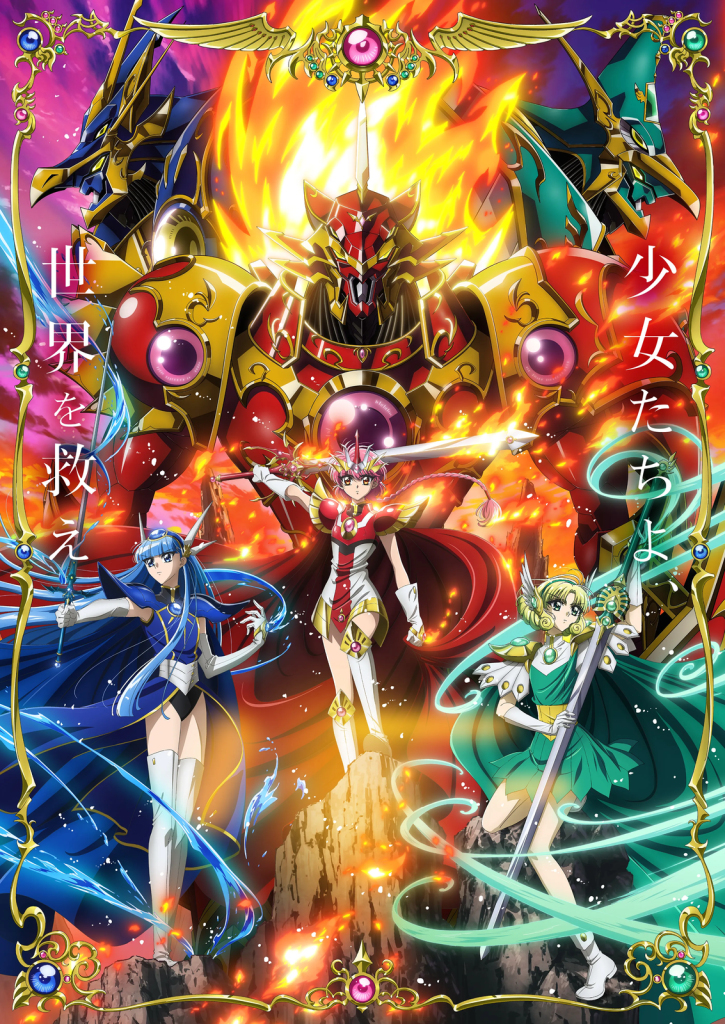
The anime’s staff confirmed on Thursday that Hikaru Midorikawa is voicing the Rune God Windom. Koji Yusa was named as the Rune God Ceres a week earlier, on November 12. Both are the towering machines the Magic Knights summon once a fight stops being something a sword can settle, and casting them like leads says a fair amount about how the new adaptation plans to treat them.
That is a shift worth noticing. In the 1990s series the Rune Gods arrived late and functioned mostly as a power-up. Here they are being announced one at a time, with named actors and their own promotional beats, which is how you build up a character rather than a weapon.
Midorikawa and Yusa are both veterans with careers stretching back to the early 1990s, so the register is going to be older and heavier than the three leads. Ayane Sakura voices Hikaru Shido, Rumi Okubo is Umi Ryuzaki and Rie Takahashi is Fu Hoji. Around them: Saori Hayami as Emeraude, Yuki Ono as Zagato, Yuki Kaji as Clef, Mika Kikuchi as Mokona, Emiri Kato as Presea, Yoshitsugu Matsuoka as Ferio, Mamiko Noto as Alcione, Ayumu Murase as Ascot, Hitomi Ueda as Caldina and Hiroki Yasumoto as Lafarga.
Who is making it
Yui Miura is directing, and this is his series directorial debut after episode-director work on Ninja Kamui and Bullet/Bullet. E&H production is animating, with Shigeru Murakoshi (Zombie Land Saga, Ninja Kamui, Apocalypse Hotel) on series scripts and Satomi Watabe (Escha Chron, Aikatsu Friends!) designing characters and serving as chief animation director. UNLIMITED PRODUCE by TMS is producing the project.
The music is split three ways between Yuki Kajiura, Takumi Ozawa and Shiho Terada. Kajiura’s name is the one that will sell this to a certain slice of the audience on its own, and a CLAMP fantasy with choral battle themes is squarely her territory.
Additional staff: Takayuki Sano as assistant director, Hiroki Mutaguchi handling Rune God design and mechanic direction, Kazumaru Ando as art director, Chiho Nakamura on color, Tomohiko Kan supervising 3D, Hitoshi Tamura as compositing director of photography, Keisuke Yanagi editing, Shuhei Abe as sound director, and Sunghoo Park credited as creative producer. Toaka performs the opening “Otome no Tsurugi” and Yurina Kawaguchi performs the ending “Hoshiakari.”
Where and when it airs
The series debuted on October 7 in the IMAnimation W block on TV Asahi and its affiliates, at 11:45 p.m. It runs for two consecutive cours, so a half-year. Crunchyroll streams it as it airs and has also produced an English dub, which went out with its own cast list in October.
The source
CLAMP serialized the manga in Kodansha’s Nakayoshi from 1993 to 1996, six volumes total. Two television seasons followed, the first from October 1994 to March 1995 and the second from April to November 1995, plus a three-episode OVA in 1997 that retold the story a different way. Media Blasters released the TV anime on VHS and DVD in the US; Discotek licensed it in 2014 and put out a complete Blu-ray and DVD collection in 2017, without the OVA.
The premise has not moved. Three schoolgirls on a Tokyo Tower field trip get pulled into Cephiro, a world collapsing because Princess Emeraude has been taken by the priest Zagato and can no longer sing the prayers that hold it together. Clef hands them magic and a job. They are fifteen.
Why the Rune God casting matters
Rayearth lives or dies on whether the escalation feels earned. The early episodes are three kids learning to cooperate in a strange world, and the whole thing tips into something much bigger once the Rune Gods show up. If those machines have presence, the second cour has a spine. Announcing their voices separately, ahead of the episodes where they matter most, is the production saying they know that.
It also fits the shape of this remake. E&H and a first-time series director with a strong action background, a Kajiura score, and a two-cour commitment is a lot of resources pointed at a 30-year-old shoujo manga. Nothing about that is a safe bet, and the Rune God announcements are the clearest sign yet that the plan is to go large rather than nostalgic. For more on the season it landed in, see our Fall 2026 ranking.
Source: Anime News Network
Featured image: Key visual for the 2026 Magic Knight Rayearth anime, via the series’ official website.