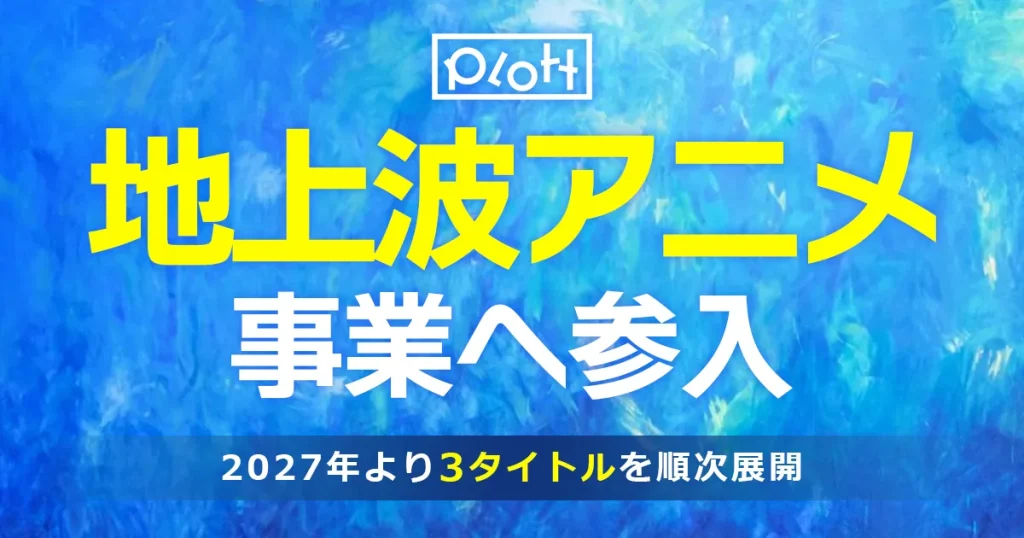
The studio Plott, best known for short anime it distributes on YouTube, is moving into traditional television. On Tuesday the company announced it will enter the terrestrial TV anime business next year, initially running three short anime series one after another on Japanese over-the-air television.
Plott says it will handle the full business around those titles — planning, production, licensing, merchandising and other development — rather than acting only as an animation contractor. More details on the individual series will be announced at a later date.
Who Plott is
Plott built its reputation on web anime shorts, and the numbers behind those channels are substantial. The company says it gathers over 900 million monthly views across all of its YouTube channels, has more than 14 million total subscribers, and has passed 24 billion total views cumulatively.
Its recent output includes Rakuraku Hanten, a new short anime that launched on YouTube on September 18, and Tengu Tōsen (Tengu Demon Sword Fight), a short anime project produced with Bandai Namco Entertainment, whose first episode arrived on July 24.
The studio also produced the Anti-Hero Generations short anime adaptation in 2022, based on Keita Uehara’s manga submission, which had won the company’s first “New Generation YouTube Manga Award” in 2021. Its other adaptations include Teikō Penguin, from Torinosasami’s manga, and Konketsu no Karekore (Karekore of Mixed Blood), from Momota Inoue’s Karekore.
Why short anime is a real business
Short-form anime — episodes that run a few minutes rather than a full broadcast slot — has become a distinct corner of the industry thanks to YouTube and social platforms. It is cheap to produce, easy to distribute, and can be tested with audiences before a larger commitment. Several studios have used it as a proving ground before pitching longer projects.
Plott’s move is the next step in that logic: take an audience already built on free platforms and translate it into television slots and licensing revenue. The fact that the company plans to handle merchandising itself, rather than simply licensing finished episodes to a broadcaster, suggests it expects these titles to become brands rather than one-off shorts.
Running three series back to back is also a deliberate strategy. A single short series is easy for viewers to miss, but an uninterrupted block of them can establish a viewing habit and give the studio three chances to find a breakout hit.
Why it matters
Terrestrial broadcast is still the highest-profile stage for anime in Japan, and it comes with different pressures than YouTube — fixed schedules, broadcast standards, and the expectation of a broader, older audience. A studio known for short-form shorts taking that step is a notable vote of confidence in the format’s staying power.
Plott is not alone in finding new distribution models for anime. Short and experimental anime have been growing steadily, and we have covered adjacent moves such as Uma Musume’s short anime Umayuru Full Gate! chasing a Guinness World Record. With three titles planned for over-the-air TV next year, Plott will be the studio to watch if the experiment works.
The obvious open questions are whether the three series will be original projects or adaptations, and how long each will run. The company has said only that the details will come later.
Source: Anime News Network.
Featured image: Studio Plott promotional image, via Anime News Network.
![Key visual for the Battle Spirits [Re] Zekkai no Ku TV anime](https://animedispatch.com/wp-content/uploads/2026/10/crunchyroll-battle-spirits-tv-anime-212x300.jpg)