South Korea’s Educational Broadcasting System will start airing five animated series made with generative AI on December 1, all drawn from a co-production project the broadcaster ran this year. The shows were picked from 429 submissions, roughly 86 entries for each slot.
EBS has set aside a dedicated block on EBS 1TV for them, running Tuesdays through Thursdays from 5:20 to 5:50 p.m. KST.
The five shows
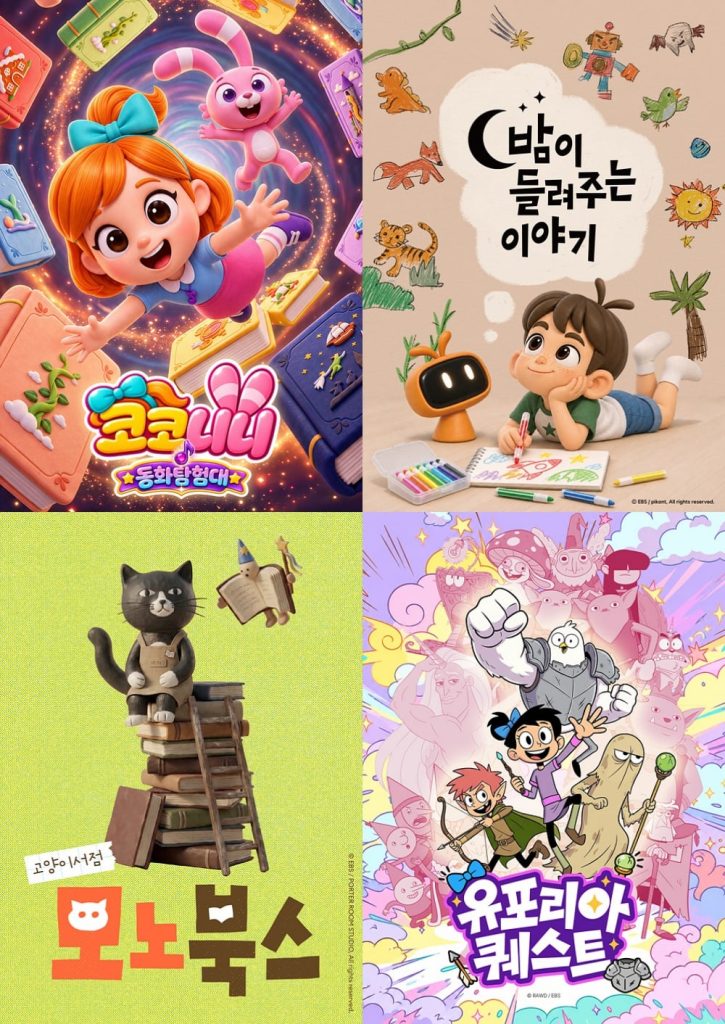
Coconini’s Fairy Tale Adventure Team opens the block on December 1 at 5:20 p.m. It is a musical fantasy about a child named Coco and Nini, a magical stuffed toy, travelling through fairy tale worlds and telling stories through songs and dance.
Stories Told by the Night follows at 5:35 p.m. The story centres on Hyeon, a lonely boy whose busy parents overlook him, and a small AI device called Bam that takes him through different story worlds. Episodes deal with understanding, patience, courage and waiting, and the visuals change with each one: felt puppets, coloured pencil drawings, clay animation and traditional Korean folk painting.
On December 2, Euphoria Quest premieres at 5:20 p.m. Four novice adventurers get separated after an explosion in a dungeon, then work through their pasts while trying to reunite and figure out what the dungeon is hiding. EBS plans to rebroadcast it Thursdays at 5:40 p.m.
Monobooks Cat Bookstore debuts at 5:30 p.m. the same day, about a quiet cat who runs a bookshop and helps animal customers through the books he recommends.
The fifth show, Yellow Socks Popo, is not part of the December launch. It arrives in March 2027, set in a facility where discarded single socks end up, with a protagonist who takes on an army of plain white socks.
What “made with AI” actually means here
The detail worth paying attention to is the mix of techniques. These are not prompt-to-video projects. EBS describes them as combining generative AI with stop-motion, 2D, 3D, clay, felt puppetry and paper cutouts, and the broadcaster says the aim was to support emerging creators and test where the technology can sit alongside handmade work rather than replace it.
That framing is doing a lot of work, and it is also the honest description of where the industry currently is. AI tools are cheap and fast at backgrounds, textures and in-between grunt work. They are not good at character acting, and every project that has tried to skip that step has looked it.
Why a public broadcaster is the one doing this
EBS is an educational channel, which changes the calculation. A commercial broadcaster experimenting with AI animation risks a staff backlash and a reputation hit. EBS gets to frame the project as a training programme for new creators with a public-service justification, and it can put the results in a children’s timeslot where the bar for visual polish is different.
Korea is not the only place running this experiment. Japan’s anime industry has been arguing about generative AI in production for two years: Felix Film edited a job listing that asked animators to use it, the Japan Actors Union published its first rules on AI and voice recordings, and studios have shipped full projects built on the technology, including a Kakao short made with OpenAI tools. A national broadcaster putting five AI-assisted series on air is the next step in that argument, and the ratings will be part of it.
Source: Anime News Network
Featured image: Promotional image for EBS’s generative AI animation block, via Anime News Network.