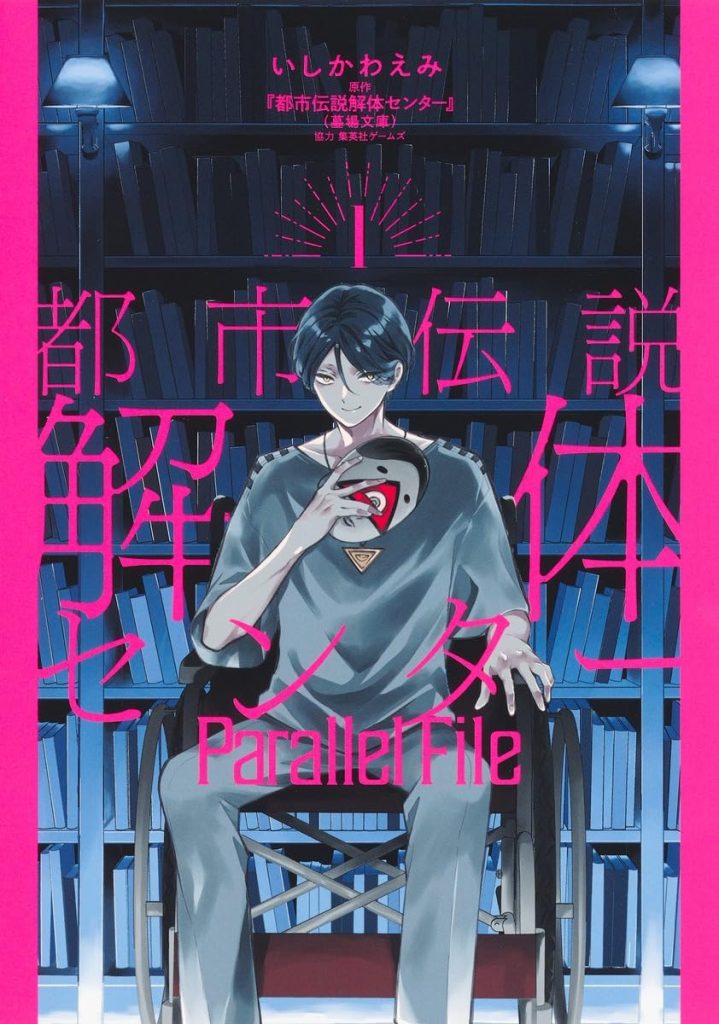
The manga adaptation of Urban Myth Dissolution Center has finished. Emi Ishikawa announced on X that Toshi Densetsu Kaitai Center: Parallel File ended in the December issue of Shueisha’s Ribon, which went on sale Monday.
The series launched in Ribon in April 2025 and ran for about nineteen months. Shueisha shipped the third compiled volume on August 19, and that book is now the adaptation’s last unless a fourth is announced.
What it adapted
Parallel File was based on Urban Myth Dissolution Center, the mystery game published by Shueisha Games. The setup follows Azami Fukurai, who works cases about urban legends under Ayumu Meguriya, a Level S psychic who runs the center.
The game arrived on PC through Steam in February 2025. Mobile versions for iOS and Android followed in March. A Nintendo Switch 2 edition launched on October 28, adding support for the Joy-Con 2’s mouse controls and a gallery for revisiting the game’s artwork.
That last detail makes the timing odd. The manga ended five days after the Switch 2 version shipped, so the adaptation closed in the same week the game reached a new audience, not months later.
A horror-adjacent game in a girls’ magazine
Ribon has been publishing since 1955 and is one of the longest-running shojo magazines in Japan. Its lineup has leaned toward romance, school stories and gentle fantasy for most of that history, which makes an urban legend title an unusual resident.
Unusual is not the same as wrong. The subject here is gossip, and the stories people tell each other about places they are afraid of. That is closer to Ribon’s register than a fight-heavy action series would be, and it gives the game a print home in a magazine whose readers do not spend their evenings on Steam.
That is the useful function of a tie-in like this. It puts a work in front of people who would never have found it otherwise, in a format that costs less than a console and fits in a school bag. Goddess of Victory: Nikke went the same route into Dengeki Maoh, and the pattern holds across publishers.
Three volumes and out
Nineteen months and three collected books is a modest run, short by the standards of a magazine serial, and also a tidy one. The adaptation has a beginning, a middle and a stopping point, and it stops.
For a licensed tie-in that shape is ordinary. These manga exist to extend a game’s reach past its own audience, they run long enough to fill a shelf, and they close. Nobody involved describes them as indefinite, and readers who expect a decade-long companion series are usually disappointed.
That also separates it from the manga that quietly stop. Boichi’s The Marshal King ended on October 16, and knowing a final chapter is coming is the part readers can plan around. A tie-in that announces its ending before the last chapter prints does the same favour, with less noise attached.
What the ending does not tell us is whether Ishikawa has something else lined up. The announcement was a single post with no further detail, and Shueisha has not said anything about a follow-up manga or a collected fourth volume.
Anyone who played the Switch 2 edition this week and went looking for the manga has arrived at the end of its run, which is a strange way to discover a series but not a bad one, since the complete story is sitting there in three books. The game itself is still on sale and still the primary version of this story. The manga was the side door into it, and the door has closed with everything inside still readable.
Source: Anime News Network — Urban Myth Dissolution Center Manga Ends
Featured image: Cover art for Toshi Densetsu Kaitai Center: Parallel File by Emi Ishikawa, via Anime News Network. © Shueisha, Emi Ishikawa.